What could a lemon, a mango, a blueberry, and an automobile possibly have in common? At first glance, absolutely nothing. Cars are associated with engineering, mechanics, speed, and technology, while fruits belong to a seemingly distant world of nature, agriculture, and gastronomy.
And yet, automotive history contains some remarkable examples of fruit names becoming associated with famous car brands, special editions, and even exclusive, one-of-a-kind automobiles.
Sometimes, the connection can be traced back to a family's history. In other cases, it emerges from a marketing strategy, a commercial partnership, or simply a nickname inspired by a car's distinctive exterior color.
Citroën: A French Automotive Brand with Roots in the Citrus Trade
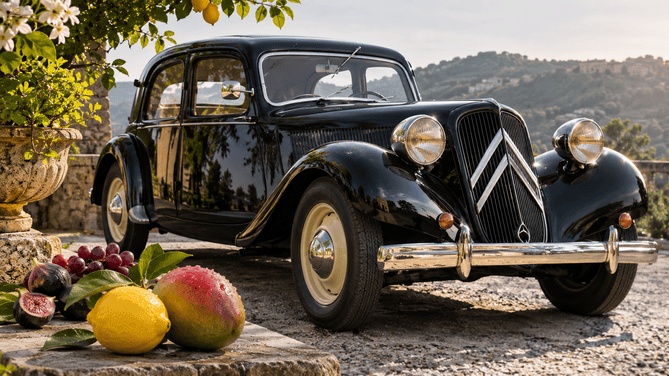
Perhaps the most fascinating example is Citroën, one of the most influential brands in European automotive history.
Although Citroën is widely regarded as a symbol of French industry, the origins of its name can actually be traced to the Netherlands, long before the first automobiles appeared.
The ancestors of André Citroën, the company's founder, lived in Amsterdam, where the family was involved in the fruit trade, particularly citrus fruits.
In the early 19th century, one of his ancestors carried the surname Limoenman, a name associated with his occupation as a citrus merchant. The family name later evolved into Citroen, which literally means "lemon" in Dutch.
The linguistic connection becomes even more intriguing when we consider that the French word citron refers to exactly the same fruit.
After the family settled in France, the surname acquired a diaeresis over the letter "e", becoming Citroën, the spelling that would eventually secure its place in automotive history.
In 1919, André Citroën established the automobile brand bearing his family name, although the name itself had never been intended as a commercial reference to a fruit.
Thus, one of the world's most influential automotive manufacturers can indirectly trace its name back to a family business specializing in citrus fruits.
A remarkable intersection of genealogy, linguistics, and industrial history!
Daihatsu Cuore Lemon Edition: When a Lemon Becomes a Car's Name
While Citroën's connection to lemons is rooted in family history, Japanese automaker Daihatsu adopted the term in a much more direct way.
During the 1990s, the small Daihatsu Cuore was marketed in special versions known as the Lemon Edition and Lemon Edition II.
Examples of these editions have survived to the present day, including vehicles first registered in Germany in 1996 and 1998.
One documented Lemon Edition II configuration featured an 847 cc three-cylinder gasoline engine producing approximately 42 horsepower, combined with a body finished in a vibrant shade of yellow.
The name "Lemon" perfectly complemented the personality of a small, economical, cheerful automobile designed for everyday urban transportation.
Unlike Citroën, where the fruit connection represents a family legacy, Daihatsu provides a clear example of a fruit name being used to identify a specific automotive edition.
A seemingly insignificant detail, perhaps, but one that now adds charm and individuality to these nearly forgotten little cars.
SEAT Mii by Mango: Where Motoring Meets Fashion
In 2014, Spanish automaker SEAT introduced a special edition of its Mii city car, developed in collaboration with the internationally renowned Spanish fashion company "MANGO".
The new model, named SEAT Mii by Mango, was unveiled at the Geneva Motor Show and represented an effort to transform an affordable urban vehicle into a product with a more sophisticated visual identity.
The special edition featured distinctive styling, exclusive finishes, and a presentation strongly influenced by the fashion industry.
Of course, SEAT did not choose the name Mango specifically to celebrate the tropical fruit. The name came from the automaker's commercial partner.
Nevertheless, the result was a production automobile whose official name included that of one of the world's most recognizable fruits.
It is a fascinating example of how names originating in completely different industries can eventually become part of automotive vocabulary.
Mercedes-Benz 500 SEL AMG "Blueberry": A Luxury Blueberry with a V8 Engine
Perhaps the most spectacular automobile in this story is a 1984 Mercedes-Benz 500 SEL AMG, affectionately known by the nickname "Blueberry".
The car was specially configured by AMG long before the German performance specialist became fully integrated into Mercedes-Benz.
Its story is particularly remarkable.
Richard Buxbaum, the founder of AMG North America and one of the key figures responsible for introducing and developing AMG's business in the United States , received the automobile as a Christmas gift arranged by Hans Werner Aufrecht, AMG's co-founder.
The car stood out thanks to its striking Lapis Blue Metallic paintwork, which covered not only the body but also numerous exterior components, creating an unusually distinctive monochromatic appearance for its era.
AMG wheels, aerodynamic enhancements, and numerous bespoke details further emphasized the vehicle's exclusive character. The interior also featured special materials and custom finishes.
Its rich blue appearance eventually inspired the nickname "Blueberry", under which the automobile became known among Mercedes-Benz and AMG enthusiasts.
In March 2025, the car was offered at an RM Sotheby's auction with a presale estimate of $150,000–$200,000.
It represents perhaps one of the most elegant contrasts between a fruit-inspired name and a prestigious luxury automobile: a V8-powered "blueberry" built for one of AMG's most influential representatives in America.
Why Do Fruit Names Appear in the Automotive World?
Looking at these examples, we discover that the relationship between fruits and automobiles does not follow a single pattern.
In Citroën's case, the story begins with a family history that predates the invention of the automobile itself.
For Daihatsu, the word Lemon became part of the identity of special editions of a compact city car.
In the case of SEAT, the name Mango entered the automotive world through a collaboration between the car industry and the fashion industry.
And for Mercedes-Benz AMG, Blueberry became an evocative nickname inspired by the striking color of a unique automobile.
These four examples demonstrate just how diverse the origins of automotive identities can be.
Although the automotive industry is dominated by technical designations, engine codes, numbers, letters, and acronyms, its history is also filled with surprisingly familiar names borrowed from everyday life.
A fruit name is easy to remember. It can evoke a color, a flavor, or a particular personality, transforming an industrial product into something with a more distinctive and approachable identity.
Conclusion: An Entire Orchard Hidden in Automotive History
From the citrus merchants of Amsterdam to AMG's workshops in Germany, fruits have found an unexpected place in the history of the automobile.
One lemon indirectly contributed to the name of one of France's most famous automotive brands. Another lemon became the name of a special Daihatsu edition. A mango found its way onto a Spanish city car, while a blueberry came to define the personality of an exclusive Mercedes-Benz AMG.
Four different stories, originating from different countries and eras, united by one seemingly ordinary detail: the names of fruits.
Cars and fruits may have very little in common from a technical perspective, but history reminds us once again that motoring is much more than an industry.
It is a world in which technology, culture, language, fashion, and personal stories intersect in the most unexpected ways.
And who knows how many other fruits might still be hiding somewhere within more than 130 years of automotive history?
Published on: