At first glance, automobiles and submarines seem to belong to entirely different worlds. One was designed to conquer roads, while the other navigates beneath the surface of the sea. Their operating environments and engineering requirements could hardly be more different.
Yet automotive history is full of unexpected connections. A Volvo once collided with a military submarine in Sweden. A British sports car shares its name with a famous submarine class. Hollywood staged an extraordinary chase across a frozen landscape. And the SAAB name links the worlds of motoring and submarine construction through Swedish industrial history.
These four stories reveal a fascinating intersection of automotive heritage, naval engineering, design, and cinema.
1. August 19, 1961: When a Volvo Collided With a Submarine
On August 19, 1961, the Swedish coastal town of Lysekil witnessed an extraordinarily unusual accident involving a Volvo PV544 and the Swedish Navy submarine HSwMS Bävern.
According to accounts of the incident, the Volvo was parked near the harbor when it began rolling downhill without a driver. The car made its way toward the waterfront and struck the bow area of the moored submarine.
The collision caused damage but, fortunately, no injuries. What makes this event remarkable is not its severity, but the sheer improbability of a road vehicle hitting a submarine. The incident has been described as a historic first, although an absolute worldwide first is difficult to verify conclusively.
There is an additional historical coincidence: both the Volvo PV544 and HSwMS Bävern belonged to the late-1950s generation of Swedish engineering. Two machines conceived for completely different environments met unexpectedly at the water's edge.
On that particular day, the automobile was the one that hit the submarine.
2. Ginetta Akula: A Supercar With a Submarine-Associated Name
Sometimes the link between automobiles and submarines is found not in a collision, but in a name. The British sports car manufacturer Ginetta introduced the Akula concept in 2019 and later presented the production version in 2024.
Akula means shark in Russian. The name is also familiar from the Akula-class nuclear-powered attack submarines, the NATO designation for Soviet Project 971 boats. Those submarines were developed for underwater operations in which propulsion, hydrodynamics, and stealth were essential considerations.
The Ginetta Akula takes a different approach to performance. Its lightweight construction, striking aerodynamic bodywork, and naturally aspirated 6.4-liter V8 engine, producing around 600 hp, are designed for speed on the road rather than beneath the waves. Ginetta announced an exclusive production run of 20 examples.
There is a compelling conceptual parallel: submarine designers seek to control water flow around a hull, while automotive engineers work to manage airflow around a body. Both disciplines draw on fluid dynamics, though their practical challenges differ considerably.
Importantly, the shared name should not be mistaken for proof that Ginetta officially named its car after the submarine class. The connection is one of terminology and evocative engineering associations, rather than an established technical collaboration.
3. The Fate of the Furious (2017): When a Submarine Chased Cars
Hollywood imagined a much more spectacular confrontation in The Fate of the Furious (2017), the eighth film in the Fast & Furious series, directed by F. Gary Gray.
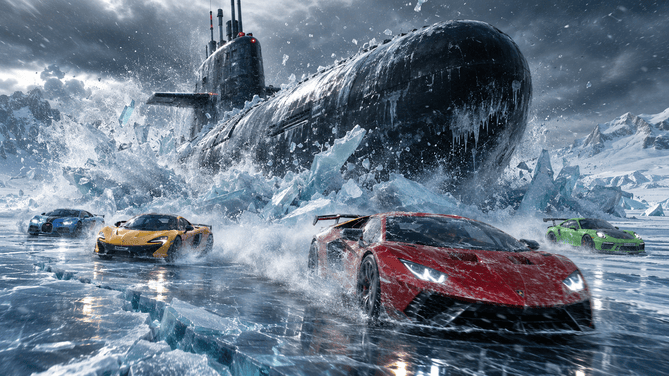
In the climactic sequence, a fleet of performance cars races across a frozen landscape as a massive submarine breaks through the ice. The vessel becomes a terrifying pursuer, with torpedoes, shattered ice, and rapid evasive maneuvers turning the scene into an unforgettable action spectacle.
The chase features striking machines, including an orange Lamborghini Murciélago and a heavily modified Dodge Charger known as the Ice Charger. The cinematic submarine is associated with the Russian Akula-class design, creating another playful connection to Ginetta's later supercar.
Although the chase is fictional and relies on visual effects, it offers an exceptionally rare cinematic image: a military submarine seemingly hunting sports cars. It is safer to call the sequence one of cinema's most unusual submarine-versus-car chases than to assert that no comparable scene exists in any other film.
Unlike the Swedish harbor incident, this time the submarine was pursuing the automobiles.
4. Saab Kockums: From an Automotive Name to Modern Submarine Engineering
Perhaps the most meaningful industrial connection comes from another Swedish name familiar to motoring enthusiasts: SAAB.
SAAB began in aviation in 1937 as Svenska Aeroplan Aktiebolaget. It later became famous for distinctive automobiles such as the SAAB 92, SAAB 99 Turbo, SAAB 900 and SAAB 9-5. Although the automobile business was separated from the aerospace and defense company, the broader SAAB name remained prominent in advanced Swedish engineering.
Today, Saab Kockums is an important specialist in military submarine design, construction, and modernization. SAAB acquired the Kockums naval shipbuilding operation in 2014, adding a long-established Swedish submarine-building capability to its defense activities.
Its work includes conventional submarine technology, air-independent propulsion, and Sweden's next-generation A26 Blekinge-class submarines.
There is a remarkable historical link back to our first story: the submarine HSwMS Bävern, involved in the 1961 Volvo collision, was built by Kockums long before the shipbuilder joined SAAB.
Thus, a story that begins with an unlikely car accident in a Swedish harbor ends with a connection to a major Swedish name in both automotive and naval history.
Conclusion: Two Different Worlds, One Unexpected History
So, could there really be a connection between submarines and automobiles? Absolutely, although the connections take very different forms.
In 1961, a Volvo physically struck a submarine. Decades later, the Ginetta Akula brought a submarine-associated name into the world of exotic sports cars. In 2017, The Fate of the Furious turned a submarine-versus-automobile confrontation into an extraordinary cinematic chase. Meanwhile, SAAB and Kockums illustrate how the histories of automotive and submarine engineering can intersect through a national industrial heritage.
These stories remind us that transportation history is rarely confined to a single environment. Cars and submarines represent different solutions to the challenge of mobility, yet both embody the determination to explore, innovate, and overcome engineering limitations.
Automotive history does not always end where the road disappears. Sometimes, it continues beneath the surface of the sea.
Published on: