Can Gastronomy and Automobiles Really Be Connected? Yes, in More Ways Than You Might Think!
From a Ferrari-powered concept car that shares its name with a famous pizza chain to a Le Mans winner who became a pasta industry executive, the relationship between food and automobiles is surprisingly rich, unexpected, and sometimes downright delicious.
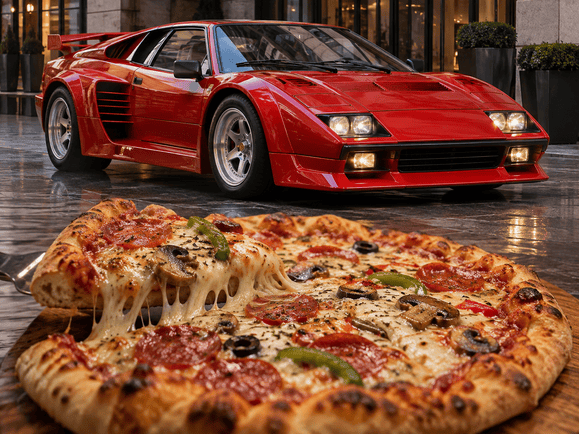
At first glance, gastronomy and the automotive industry appear to inhabit completely different worlds. One celebrates ingredients, flavors, and culinary traditions; the other is driven by engineering, design, speed, and technological innovation.
Look more closely, however, and some fascinating connections emerge. Food has inspired vehicle names, shaped marketing campaigns, and become part of the culture of motorsport. Certain remarkable individuals have even built careers on both sides of this divide.
From pizza and pasta to pistachios and ice cream, here are five stories that reveal how the dining table and the automobile can intersect.
1. Sbarro Super Eight: The Fastest Pizza Delivery Car That Never Delivered Pizza
Imagine ordering a pizza and hearing the roar of a Ferrari V8 approaching your doorstep. The idea sounds like an extravagant advertising stunt, but it becomes irresistible when we consider an unusual car unveiled in 1984: the Sbarro Super Eight.
Presented at the Geneva Motor Show by Swiss-based designer Franco Sbarro, the Super Eight was a compact, dramatically styled performance car built around Ferrari 308 GTB mechanical components. Its mid-mounted V8 engine, striking bodywork, wide arches, and unmistakably 1980s appearance made it anything but an ordinary hatchback.
Meanwhile, the name Sbarro was already familiar to pizza lovers. The American restaurant business began in Brooklyn, New York, in 1956, when Italian immigrants Carmela and Gennaro Sbarro opened their delicatessen. It later grew into an international pizza chain.
There is an important distinction: Franco Sbarro's automotive business had no affiliation with the Sbarro pizza chain. Their shared name was a coincidence, not a commercial collaboration. The Super Eight was never designed as a pizza delivery vehicle.
Nevertheless, the image of a Ferrari-powered hatchback carrying a fresh pizza is too entertaining to ignore. Automotive writers have jokingly described the Super Eight as the ultimate—or fastest—pizza delivery car, turning a coincidence of names into a memorable piece of automotive humor.
With only a single example produced, this remarkable car remains an exotic rarity. If it had ever been pressed into pizza-delivery service, the food might have arrived remarkably quickly—but practical cargo space would have been another matter entirely.
2. Paolo Barilla: From the Racetrack to the Pasta Industry
Some links between cuisine and motoring are coincidences. The story of Paolo Barilla, however, is a genuine connection between two demanding professional worlds.
Born in Milan in 1961, Barilla became an accomplished racing driver before taking on a senior leadership role in his family's internationally recognized food company, the Barilla Group.
His greatest sporting triumph came at the 1985 24 Hours of Le Mans, where he shared the winning Porsche 956 with Klaus Ludwig and Louis Krages, known in racing as John Winter. Winning this legendary endurance event placed him among an elite group of drivers capable of combining speed, stamina, strategic judgment, and mechanical sympathy.
Barilla subsequently competed in Formula 1 with Minardi during the 1989 and 1990 seasons. After his racing career, he devoted increasing attention to the family enterprise and became Deputy Chairman of the Barilla Group.
The two worlds converged spectacularly in 2025, when Barilla announced an official partnership with Formula 1, bringing Italian pasta and food-centered hospitality closer to the modern championship.
Precision, preparation, teamwork, and consistency matter in both motorsport and food production. Whether the objective is winning an endurance race or maintaining quality across millions of meals, exceptional results depend on getting countless small details right.
For Paolo Barilla, the connection between pasta and racing is not a marketing metaphor. It is part of his personal history.
3. Mitsubishi Pistachio: A Small Japanese Car Named After an Edible Seed
Automakers routinely borrow names from animals, landscapes, and mythology. In December 1999, Mitsubishi Motors found inspiration in something much closer to the kitchen: the pistachio.
The Mitsubishi Pistachio was a small three-door Japanese hatchback with a name recalling the edible seed of Pistacia vera, a small tree belonging to the cashew family. Pistachios are familiar ingredients in pastries, desserts, ice cream, confectionery, and savory cuisine.
Yet the name was not simply a playful food reference. The pistachio's natural green associations suited a car designed to showcase environmentally conscious engineering and fuel efficiency.
Derived from the Mitsubishi Minica, the Pistachio used a 1.1-liter gasoline direct-injection engine and an automatic stop-and-restart system intended to reduce fuel consumption while stationary. Mitsubishi reported fuel economy of 30 km/L under Japan's historical 10-15-mode test cycle—approximately 3.33 liters per 100 kilometers.
Just 50 examples were produced, principally for public authorities and organizations engaged in environmental activities, making the Pistachio an exceptionally uncommon model.
Its friendly name and genuinely innovative technical specification made it an unusual pioneer of fuel-saving ideas that would become much more widespread in later automobiles.
4. Chery QQ Ice Cream: An Electric Car with a Dessert-Inspired Identity
If a car named after a pistachio seems unusual, how about one called Ice Cream?
Chinese automaker Chery introduced the QQ Ice Cream in December 2021 as a tiny battery-electric city car. With its compact proportions, friendly styling, and cheerful colors, it targeted motorists looking for inexpensive, straightforward urban transportation.
The dessert inspiration extended to the model range. Early versions carried names such as Pudding, Cone, and Sundae, making the manufacturer's catalogue sound almost like an ice cream menu.
The original vehicle measured roughly 2.98 meters long and offered four seats within a minimal urban footprint. Its small electric drivetrain was intended for modest city speeds and short everyday journeys, rather than long-distance touring or sporting performance.
Its branding, however, was as important as its engineering. Rather than evoke power or aggression, the Ice Cream name suggested something fun, accessible, colorful, and easy to enjoy.
In an increasingly competitive electric-vehicle market, this was an example of how a manufacturer could use the emotional associations of food to give a practical, low-cost product a memorable personality.
5. Luigi Montanini: The First Cook of Formula 1
Modern Formula 1 paddocks include impressive hospitality facilities, experienced catering personnel, and carefully prepared meals. But this level of organization did not always exist.
An important figure in the development of paddock food culture was Italian chef Luigi Montanini, affectionately nicknamed "Pasticcino". He is widely remembered as the pioneering cook of the Formula 1 paddock.
Born in Maranello, the town associated with Ferrari, Montanini was brought into the Scuderia's racing world during the late 1970s to prepare meals for the team. His early culinary facilities were much more modest than today's enormous hospitality structures.
Montanini became known for traditional Italian cooking—especially pasta—but his contribution went beyond providing food. At a time of fierce competition and demanding travel schedules, a shared meal could offer drivers, mechanics, engineers, and even rival teams a brief sense of familiarity and community.
A plate of pasta created an opportunity to talk, relax, and set aside sporting rivalries. In this way, cooking became part of the social fabric of international motorsport.
His legacy returned to the spotlight in 2025, as Barilla's relationship with Formula 1 provided an occasion to celebrate the chef's place in the championship's history.
Montanini's story reminds us that behind the technical sophistication and competitive intensity of elite racing are people who still need the most human of experiences: a good meal and a place to share it.
More Than Coincidence: Two Worlds with a Shared Passion
These five stories represent very different connections between gastronomy and automobiles. The Sbarro Super Eight offers an entertaining coincidence of names. Paolo Barilla brings firsthand racing achievements into the food industry. The Mitsubishi Pistachio and Chery QQ Ice Cream demonstrate how food-inspired names can communicate environmental awareness or an approachable personality. Luigi Montanini shows that cooking helped shape the traditions of Formula 1 itself.
Both gastronomy and automotive engineering reward creativity, technical expertise, experimentation, and meticulous attention to detail. A chef balances flavors, temperatures, and preparation times; an engineer balances materials, systems, performance, and efficiency. Each discipline combines tradition with innovation.
Conclusion: Automotive History Has Some Surprising Ingredients
Can gastronomy and automobiles really be connected? Absolutely—and in more ways than one.
A sports car sharing its name with a pizza chain, a Le Mans champion involved in the pasta industry, an efficient Japanese hatchback named after a nut, a Chinese electric car with a dessert-inspired identity, and a pioneering Formula 1 cook all prove that automotive history reaches well beyond engines, factories, and racetracks.
It crosses into language, business, culture, and everyday life—even the food on our plates.
At Daily Car Facts, we believe that some of the best automotive discoveries begin with an unexpected question. And sometimes, the most fascinating stories come with a delicious twist.
Published on: