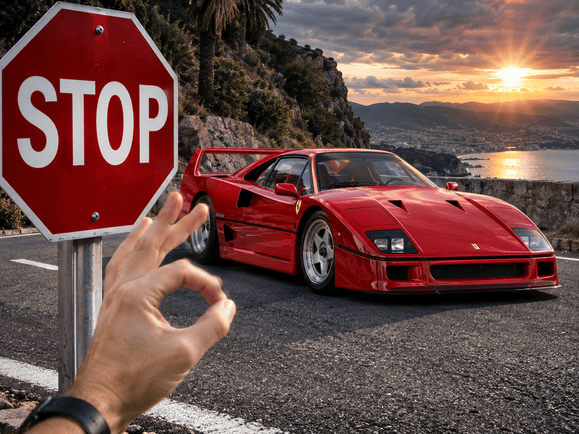
The name Ferrari is almost universally associated with speed, passion, exclusivity, racing victories, and some of the most desirable automobiles ever created. For generations of enthusiasts, the famous Prancing Horse has represented the pinnacle of Italian automotive engineering, a symbol inseparable from Enzo Ferrari and the factory in Maranello.
Yet automotive history contains remarkable coincidences. What if a vehicle carried the Ferrari name but had absolutely nothing to do with Maranello? What if a Brazilian company named Ferrari was building Ford-based vehicles? What if a tiny German FIAT displayed a badge reminiscent of the Prancing Horse?
These are genuine chapters of motoring history, and each reveals a different distinction between a familiar name and the identity behind it.
1. Ferves Ranger: The Little Italian Ferrari That Was Never a Ferrari
In 1966, visitors to the Turin Motor Show encountered an unusual compact off-roader called the Ferves Ranger. Its minimalist body, tiny wheels, and practical proportions were designed for rural roads and difficult terrain, not glamorous boulevards.
The company name Ferves was an abbreviation of Ferrari Veicoli Speciali — Ferrari Special Vehicles. Despite the surname, the company was unrelated to Enzo Ferrari's celebrated sports-car manufacturer. It was established in Turin in 1965 by Carlo Ferrari, who set out to create economical utility vehicles using proven FIAT components.
The Ranger borrowed its rear-mounted, air-cooled two-cylinder engine from the FIAT 500 and suspension components from the FIAT 600. With approximately 18 horsepower from a 499 cc engine, the little vehicle could hardly compete with the fastest Ferraris. But its simplicity, compact dimensions, folding windscreen, and ability to carry passengers or light cargo made it genuinely useful.
Initially offered with rear-wheel drive, the Ranger later appeared in four-wheel-drive form. Production began in 1967 and ended in 1971; approximately 600 examples are commonly reported to have been produced.
Today, surviving Rangers are rare collectors' curiosities. Here was a Ferrari-derived name attached to a tiny off-roader with fewer than 20 horsepower: a Ferrari by surname, but not by manufacturer or engineering philosophy.
2. Ferrari in Brazil: The Forgotten Coachbuilder That Worked With Ford
Far from Maranello, another unrelated Ferrari operated in São Paulo, Brazil, during the 1950s and 1960s. Rather than producing Italian sports cars, the Brazilian coachbuilder specialized in practical vehicle bodies and commercial conversions, often based on Ford platforms.
Brazil's domestic automotive industry was developing rapidly, and specialist coachbuilders were well placed to fill gaps left by major manufacturers. The São Paulo company developed an important relationship with Ford, creating unusually versatile adaptations of the Ford F-100 pick-up truck.
In 1959, encouraged by Ford, the Brazilian Ferrari developed an elongated passenger-carrying conversion of the F-100. Its station-wagon-like appearance featured a spacious cabin, panoramic rear glazing, seating for up to eight occupants, and access to luggage through a large rear opening.
The workshop later offered double-cab pick-up trucks, ambulances, police vehicles, vans and other commercial bodies. Some conversions appeared in Ford promotional materials and Brazilian automotive exhibitions.
An especially imaginative project appeared in 1965: a specialized delivery van commissioned by Lufthansa's São Paulo agency. Based on the F-100 chassis, it used a forward-control driving arrangement that required repositioning the steering and pedals. Its purpose-built steel body included a wooden cargo floor, cabin partition, and practical loading doors.
In 1967, the Brazilian Ferrari operation ceased using that name and was succeeded by Decândia, which continued work in specialized vehicle bodywork. The contrast is striking: while Ferrari sports cars were conquering racetracks, an unrelated Brazilian Ferrari was designing working vehicles for businesses and public services.
3. Steinwinter: When a FIAT Wore a Prancing Horse
One of the most unexpected Ferrari-like identities comes from Germany. Steinwinter offered versions of the FIAT 500 and FIAT 126 that carried an emblem remarkably reminiscent of Ferrari's famous badge: a rearing horse on a yellow background.
Beginning around 1969, the German manufacturer specialized in small cars adapted for specific local licensing and vehicle categories. Some FIAT-derived models used tiny 250 cc engines, including power units associated with the Goggomobil, offering approximately 13.5 to 15 horsepower.
The result was a remarkable visual contradiction: a miniature, low-powered car displaying a symbol easily confused with one associated with exotic Italian supercars. Steinwinter also experimented with unconventional small vehicles, including the Junior 50, and remained active in automotive projects into the 1980s.
The resemblance should not be mistaken for evidence of a Ferrari collaboration. The rearing horse also has a historic heraldic connection to Stuttgart, while Ferrari's own emblem is associated with the Italian First World War pilot Francesco Baracca and the yellow color of Modena.
The Steinwinter story illustrates how similar-looking automotive symbols can arise in completely different contexts. These FIAT-based cars were not secret Ferraris; they belonged to a different world of economical personal transport.
4. Ferrari Testa Rossa J: A Genuine Ferrari Built Outside Maranello
The previous stories involve unrelated names or lookalike symbols. The Ferrari Testa Rossa J reverses the situation: it is an officially licensed Ferrari product manufactured outside Maranello.
Developed in Britain by The Little Car Company, now known as Hedley Studios, the Testa Rossa J is a meticulously crafted electric reproduction of the legendary Ferrari 250 Testa Rossa racing car. The project was developed directly with Ferrari and involved Ferrari Classiche archival material.
At approximately 75 percent of the original vehicle's size, it features aluminum bodywork, a tubular chassis, and design elements carefully inspired by the historic racer. Its cabin uses authentic Ferrari materials, and it wears an officially sanctioned Prancing Horse badge.
Instead of a V12 engine, the Testa Rossa J employs an electric motor delivering around 12 kW — roughly 16 horsepower. Depending on specification and mode, it can reach approximately 80 km/h. Novice, Comfort, Sport, and Race modes adjust its driving characteristics.
Production was limited to 299 planned examples. According to accounts attributed to company founder Ben Hedley, Ferrari representatives described it as the first Ferrari built outside Maranello. That characterization belongs to this special licensed project, not to Ferrari's regular full-size road-car manufacturing.
The paradox is charming: an officially authorized Ferrari without the expected Ferrari engine, built in Britain rather than at the familiar Italian factory. What looks at first like a luxurious miniature is a distinctive, legitimate collaboration in the Ferrari universe.
5. AF Corse: A Ferrari Racing Team Led by a Ferrari Unrelated to Ferrari
The most entertaining coincidence may belong to motorsport. AF Corse competes with Ferrari racing machinery, works closely with Maranello, and is led by a man named Ferrari. Yet founder Amato Ferrari is not a relative of Enzo Ferrari.
A former racing driver, Amato Ferrari moved into team-management activities in 1995. AF Corse was formally established in 2002 in Piacenza, Italy; its name derives from his initials. The distinction matters: the founder's earlier career is not the same as the official foundation date of the team.
The organization initially developed important experience in touring-car and GT competition, including involvement with Maserati and the MC12. In 2006, it began an enduring relationship with Ferrari GT programs.
AF Corse subsequently raced Ferrari F430, 458 Italia, 488 and 296 competition cars, becoming one of the most accomplished teams in international GT and endurance racing. Its expertise extends from vehicle preparation and engineering to logistics and race strategy.
The team also became closely involved in Ferrari's 499P Hypercar program, which claimed overall victories at the 24 Hours of Le Mans in 2023, 2024, and 2025.
Amato Ferrari's connection to Ferrari was earned through racing accomplishments and a professional partnership — not inherited through family ancestry. His surname is a coincidence; his role in Ferrari's racing history is anything but.
The Ferrari Paradox: Names, Symbols, and Identities
These five stories reveal five distinct relationships to a famous automotive identity. Ferves shared a surname; the Brazilian Ferrari shared a company name; Steinwinter used a visually similar emblem; the Testa Rossa J was an officially authorized collaboration; and AF Corse became a trusted motorsport partner under the leadership of a man named Ferrari.
Together, they show why names and badges can be misleading. Behind the familiar symbols of motoring lie forgotten workshops, specialist engineers, independent businesses, and surprising coincidences.
Perhaps the greatest irony is that some vehicles bearing the Ferrari name were never Ferraris at all, while one of the most unusual genuine Ferraris was never built in Maranello.
Sometimes, discovering that a Ferrari is not really a Ferrari makes the story even more fascinating.